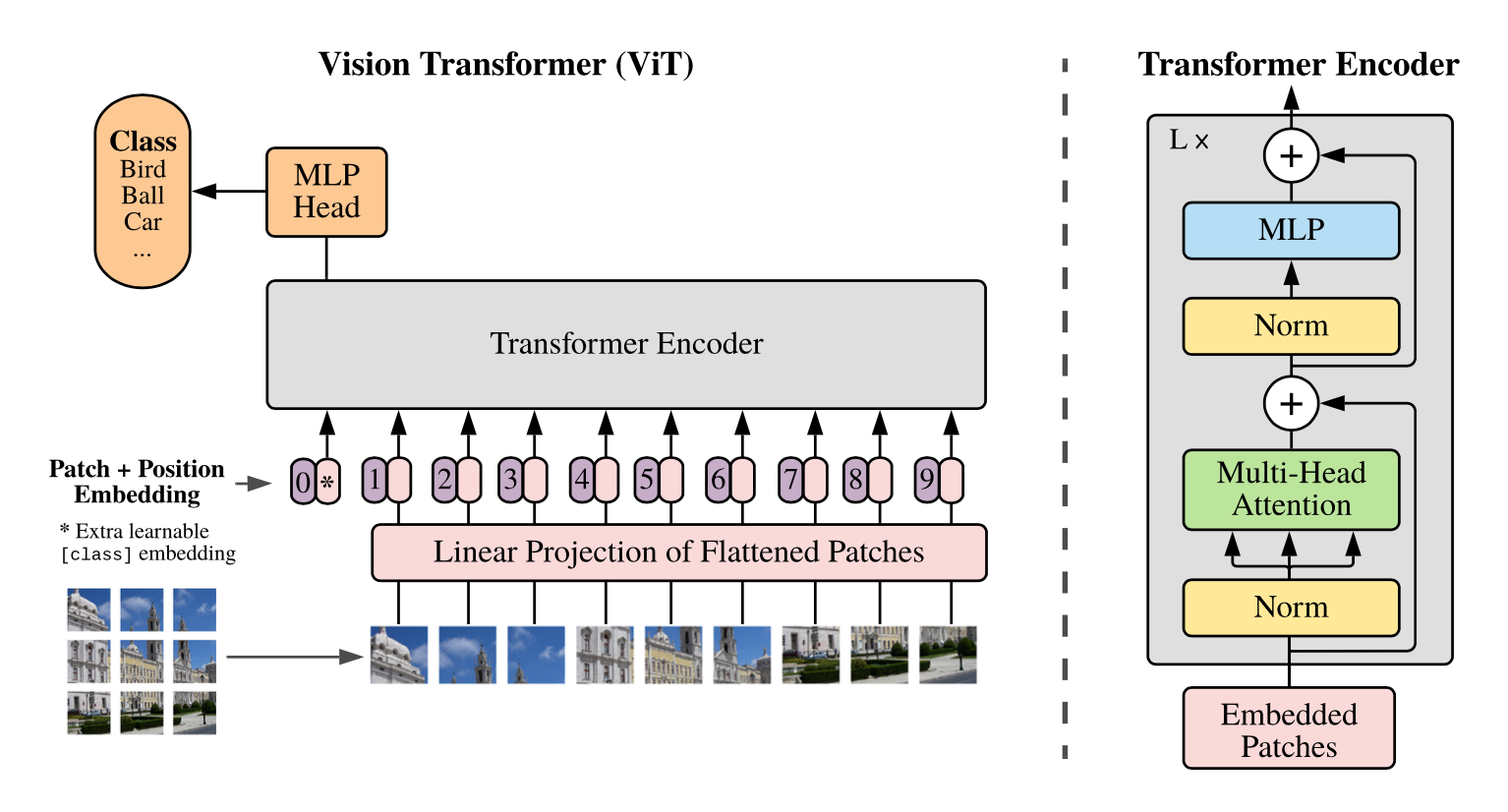
ViT(vision transformer)是Google在2020年提出的直接将transformer应用在图像分类的模型,后面很多的工作都是基于ViT进行改进的。ViT的思路很简单:直接把图像分成固定大小的patchs,然后通过线性变换得到patch embedding,这就类比NLP的words和word embedding,由于transformer的输入就是a sequence of token embeddings,所以将图像的patch embeddings送入transformer后就能够进行特征提取从而分类了。ViT模型原理如下图所示,其实ViT模型只是用了transformer的Encoder来提取特征(原始的transformer还有decoder部分,用于实现sequence to sequence,比如机器翻译)。下面将分别对各个部分做详细的介绍。
Patch Embedding
对于ViT来说,首先要将原始的2-D图像转换成一系列1-D的patch embeddings,这就好似NLP中的word embedding。输入的2-D图像记为 \(x\in \mathbb{R}^{H\times W\times C}\),其中 \(H\) 和 \(W\) 分别是图像的高和宽,而\(C\)为通道数对于RGB图像就是3。如果要将图像分成大小为 \(P\times P\)的patchs,可以通过reshape操作得到a sequence of patchs:\(x_p\in\mathbb{R}^{N\times(P^2\cdot C)}\),图像共切分为 \(N=HW/P^2\) 个patchs,这也就是sequence的长度了,注意这里直接将patch拉平为1-D,其特征大小为 \(P^2\cdot C\)。然后通过一个简单的线性变换将patchs映射到 \(D\) 大小的维度,这就是patch embeddings:\(x_p^{'}\in \mathbb{R}^{N\times D}\),在实现上这等同于对 \(x_p\) 进行一个 \(P\times P\) 且stride为 \(P\) 的卷积操作(虽然等同,但是ViT其实是不包含任何卷积操作的),下面是具体的实现代码:
class PatchEmbed(nn.Module):
    """ Image to Patch Embedding
    """
    def __init__(self, img_size=224, patch_size=16, in_chans=3, embed_dim=768):
        super().__init__()
        img_size = to_2tuple(img_size)
        patch_size = to_2tuple(patch_size)
        num_patches = (img_size[1] // patch_size[1]) * (img_size[0] // patch_size[0])
        self.img_size = img_size
        self.patch_size = patch_size
        self.num_patches = num_patches

        self.proj = nn.Conv2d(in_chans, embed_dim, kernel_size=patch_size, stride=patch_size)

    def forward(self, x):
        B, C, H, W = x.shape
        # FIXME look at relaxing size constraints
        assert H == self.img_size[0] and W == self.img_size[1], \
            f"Input image size ({H}*{W}) doesn't match model ({self.img_size[0]}*{self.img_size[1]})."
        x = self.proj(x).flatten(2).transpose(1, 2)
        return x
Position Embedding
除了patch embeddings,模型还需要另外一个特殊的position embedding。transformer和CNN不同,需要position embedding来编码tokens的位置信息,这主要是因为self-attention是permutation-invariant,即打乱sequence里的tokens的顺序并不会改变结果。如果不给模型提供patch的位置信息,那么模型就需要通过patchs的语义来学习拼图,这就额外增加了学习成本。ViT论文中对比了几种不同的position embedding方案(如下),最后发现如果不提供positional embedding效果会差,但其它各种类型的positional embedding效果都接近,这主要是因为ViT的输入是相对较大的patchs而不是pixels,所以学习位置信息相对容易很多。
- 无positional embedding
- 1-D positional embedding:把2-D的patchs看成1-D序列
- 2-D positional embedding:考虑patchs的2-D位置(x, y)
- Relative positional embeddings:patchs的相对位置
transformer原论文中是默认采用固定的positional embedding,但ViT中默认采用学习(训练的)的1-D positional embedding,在输入transformer的encoder之前直接将patch embeddings和positional embedding相加:
# 这里多1是为了后面要说的class token,embed_dim即patch
self.pos_embed= nn.Parameter(torch.zeros(1, num_patches+ 1, embed_dim))

# patch emded + pos_embed
x = x + self.pos_embed
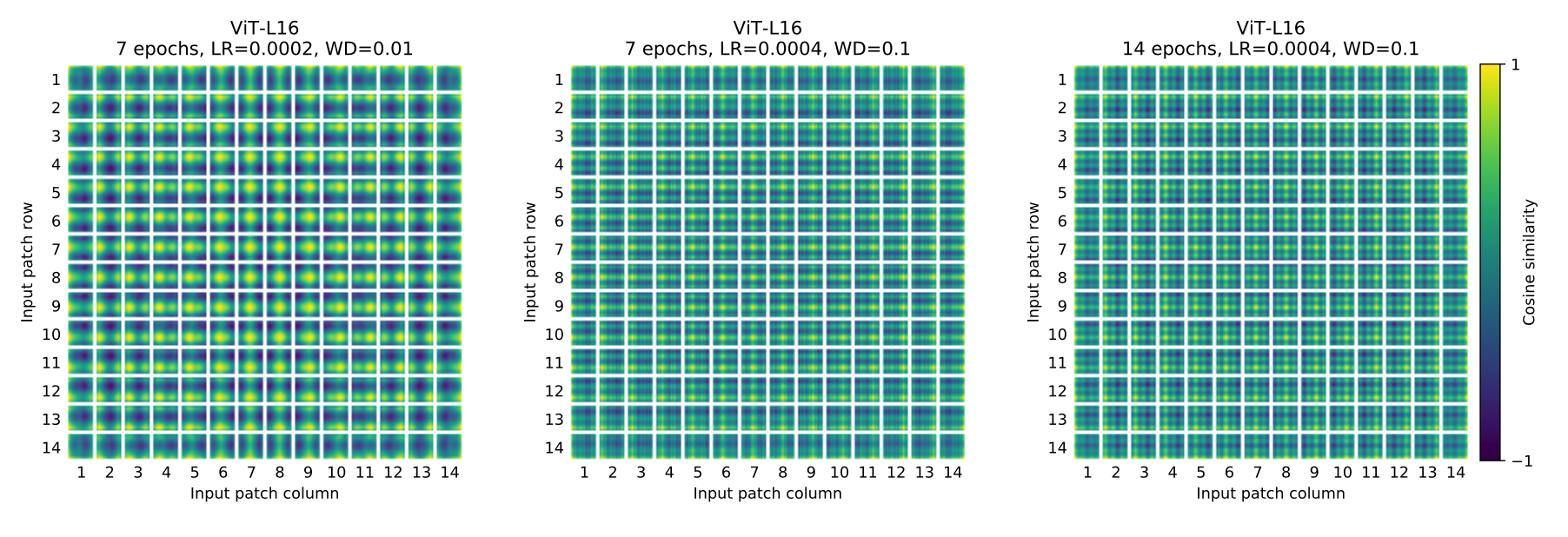
论文中也对学习到的positional embedding进行了可视化,发现相近的patchs的positional embedding比较相似,而且同行或同列的positional embedding也相近:
这里额外要注意的一点,如果改变图像的输入大小,ViT不会改变patchs的大小,那么patchs的数量 \(N\) 会发生变化,那么之前学习的pos_embed就维度对不上了,ViT采用的方案是通过插值来解决这个问题:
def resize_pos_embed(posemb, posemb_new):
    # Rescale the grid of position embeddings when loading from state_dict. Adapted from
    # https://github.com/google-research/vision_transformer/blob/00883dd691c63a6830751563748663526e811cee/vit_jax/checkpoint.py#L224
    _logger.info('Resized position embedding: %s to %s', posemb.shape, posemb_new.shape)
    ntok_new = posemb_new.shape[1]
    # 除去class token的pos_embed
    posemb_tok, posemb_grid = posemb[:, :1], posemb[0, 1:]
    ntok_new -= 1
    gs_old = int(math.sqrt(len(posemb_grid)))
    gs_new = int(math.sqrt(ntok_new))
    _logger.info('Position embedding grid-size from %s to %s', gs_old, gs_new)
    # 把pos_embed变换到2-D维度再进行插值
    posemb_grid = posemb_grid.reshape(1, gs_old, gs_old, -1).permute(0, 3, 1, 2)
    posemb_grid = F.interpolate(posemb_grid, size=(gs_new, gs_new), mode='bilinear')
    posemb_grid = posemb_grid.permute(0, 2, 3, 1).reshape(1, gs_new * gs_new, -1)
    posemb = torch.cat([posemb_tok, posemb_grid], dim=1)
    return posemb
但是这种情形一般会造成性能少许损失,可以通过finetune模型来解决。另外最新的论文CPVT通过implicit Conditional Position encoding来解决这个问题(插入Conv来隐式编码位置信息,zero padding让Conv学习到绝对位置信息)。
Class Token
除了patch tokens,ViT借鉴BERT还增加了一个特殊的class token。后面会说,transformer的encoder输入是a sequence patch embeddings,输出也是同样长度的a sequence patch features,但图像分类最后需要获取image feature,简单的策略是采用pooling,比如求patch features的平均来获取image feature,但是ViT并没有采用类似的pooling策略,而是直接增加一个特殊的class token,其最后输出的特征加一个linear classifier就可以实现对图像的分类(ViT的pre-training时是接一个MLP head),所以输入ViT的sequence长度是 \(N+1\)。class token对应的embedding在训练时随机初始化,然后通过训练得到,具体实现如下:
# 随机初始化
self.cls_token = nn.Parameter(torch.zeros(1, 1, embed_dim))

# Classifier head
self.head= nn.Linear(self.num_features, num_classes) if num_classes> 0 else nn.Identity()

# 具体forward过程
B= x.shape[0]
x= self.patch_embed(x)
cls_tokens= self.cls_token.expand(B,-1,-1)# stole cls_tokens impl from Phil Wang, thanksx= torch.cat((cls_tokens, x), dim=1)
x= x+ self.pos_embed
Transformer Encoder
transformer最核心的操作就是self-attention,其实attention机制很早就在NLP和CV领域应用了,比如带有attention机制的seq2seq模型,但是transformer完全摒弃RNN或LSTM结构,直接采用attention机制反而取得了更好的效果:attention is all you need!简单来说,attention就是根据当前查询对输入信息赋予不同的权重来聚合信息,从操作上看就是一种“加权平均”。attention中共有3个概念:query, key和value,其中key和value是成对的,对于一个给定的query向量 \(q\in\mathbb{R}^d\),通过内积计算来匹配k个key向量(维度也是\(d\),堆积起来即矩阵 \(K \in\mathbb{R}^{k\times d}\)),得到的内积通过softmax来归一化得到 \(k\) 个权重,那么对于query其attention的输出就是k个key向量对应的value向量(即矩阵 \(V \in \mathbb{R}^{k\times d}\))的加权平均值。对于一系列的 \(N\) 个query(即矩阵 \(Q\in\mathbb{R}^{N\times d}\) ),可以通过矩阵计算它们的attention输出:
这里的 \(\sqrt{d_k}\) 为缩放因子以避免点积带来的方差影响。上述的Attention机制称为 Scaled dot product attention,其实attention机制的变种有很多,但基本原理是相似的。如果 \(Q,K,V\)都是从一个包含 \(N\) 个向量的sequence( \(X\in \mathbb{R}^{N\times D}\) )通过线性变换得到:\(Q = XW_Q,K=XW_K,V+XW_V\) 那么此时就变成了 self-attention,这个时候就有 \(N\) 个(key,value)对,那么\(k=N\) 。self-attention是transformer最核心部分,self-attention其实就是输入向量之间进行相互attention来学习到新特征。前面说过我们已经得到图像的patch sequence,那么送入self-attention就能到同样size的sequence输出,只不过特征改变了。
更进一步,transformer采用的是 multi-head self-attention (MSA),所谓的MSA就是采用定义 \(h\) 个attention heads,即采用 \(h\) 个self-attention应用在输入sequence上,在操作上可以将sequence拆分成\( h\) 个size为 \(N\times d\) 的sequences,这里 \(D = hd\),\(h\) 个不同的heads得到的输出concat在一起然后通过线性变换得到最终的输出,size也是 \(N\times D\):
MSA的计算量是和 \(N^2\) 成正相关的,所以ViT的输入是patch embeddings,而不是pixel embeddings,这有计算量上的考虑。在实现上,MSA是可以并行计算各个head的,具体代码如下:
class Attention(nn.Module):
    def __init__(self, dim, num_heads=8, qkv_bias=False, qk_scale=None, attn_drop=0., proj_drop=0.):
        super().__init__()
        self.num_heads = num_heads
        head_dim = dim // num_heads

        self.scale = qk_scale or head_dim ** -0.5

        self.qkv = nn.Linear(dim, dim * 3, bias=qkv_bias)
        self.attn_drop = nn.Dropout(attn_drop)
        self.proj = nn.Linear(dim, dim)
        # 这里包含了dropout
				self.proj_drop = nn.Dropout(proj_drop)

    def forward(self, x):
        B, N, C = x.shape
        qkv = self.qkv(x).reshape(B, N, 3, self.num_heads, C // self.num_heads).permute(2, 0, 3, 1, 4)
        q, k, v = qkv[0], qkv[1], qkv[2]   # make torchscript happy (cannot use tensor as tuple)

								attn = (q @ k.transpose(-2, -1)) * self.scale
        attn = attn.softmax(dim=-1)
        attn = self.attn_drop(attn)

        x = (attn @ v).transpose(1, 2).reshape(B, N, C)
        x = self.proj(x)
        x = self.proj_drop(x)
        return x
在transformer中,MSA后跟一个FFN(Feed-forward network),这个FFN包含两个FC层,第一个FC层将特征从维度\(D\) 变换成 \(4D\),后一个FC层将特征从维度\(4D\) 恢复成 \(D\),中间的非线性激活函数采用GeLU,其实这就是一个MLP,具体实现如下:
class Mlp(nn.Module):
    def __init__(self, in_features, hidden_features=None, out_features=None, act_layer=nn.GELU, drop=0.):
        super().__init__()
        out_features = out_features or in_features
        hidden_features = hidden_features or in_features
        self.fc1 = nn.Linear(in_features, hidden_features)
        self.act = act_layer()
        self.fc2 = nn.Linear(hidden_features, out_features)
        self.drop = nn.Dropout(drop)

    def forward(self, x):
        x = self.fc1(x)
        x = self.act(x)
        x = self.drop(x)
        x = self.fc2(x)
        x = self.drop(x)
        return x
那么一个完成transformer encoder block就包含一个MSA后面接一个FFN,其实MSA和FFN均包含和ResNet一样的skip connection,另外MSA和FFN后面都包含layer norm层,具体实现如下:
class Block(nn.Module):

    def __init__(self, dim, num_heads, mlp_ratio=4., qkv_bias=False, qk_scale=None, drop=0., attn_drop=0.,
                 drop_path=0., act_layer=nn.GELU, norm_layer=nn.LayerNorm):
        super().__init__()
        self.norm1 = norm_layer(dim)
        self.attn = Attention(
            dim, num_heads=num_heads, qkv_bias=qkv_bias, qk_scale=qk_scale, attn_drop=attn_drop, proj_drop=drop)
        # NOTE: drop path for stochastic depth, we shall see if this is better than dropout here
        self.drop_path = DropPath(drop_path) if drop_path > 0. else nn.Identity()
        self.norm2 = norm_layer(dim)
        mlp_hidden_dim = int(dim * mlp_ratio)
        self.mlp = Mlp(in_features=dim, hidden_features=mlp_hidden_dim, act_layer=act_layer, drop=drop)

    def forward(self, x):
        x = x + self.drop_path(self.attn(self.norm1(x)))
        x = x + self.drop_path(self.mlp(self.norm2(x)))
        return x
ViT
对于ViT模型来说,就类似CNN那样,不断堆积transformer encoder blocks,最后提取class token对应的特征用于图像分类,论文中也给出了模型的公式表达,其中
- (1)就是提取图像的patch embeddings,然后和class token对应的embedding拼接在一起并加上positional embedding;
- (2)是MSA,(3)是MLP,(2)和(3)共同组成了一个transformer encoder block,共有\(L\)层;
- (4)是对class token对应的输出做layer norm,然后就可以用来图像分类。
除了完全无卷积的ViT模型外,论文中也给出了Hybrid Architecture,简单来说就是先用CNN对图像提取特征,从CNN提取的特征图中提取patch embeddings,CNN已经将图像降采样了,所以patch size可以为 \(1\times 1\)。
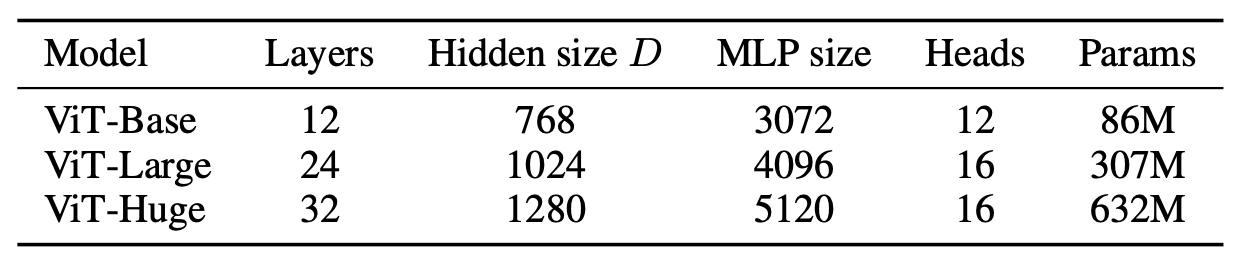
ViT模型的超参数主要包括以下,这些超参数直接影响模型参数以及计算量:
- Layers:block的数量;
- Hidden size D:隐含层特征,D在各个block是一直不变的;
- MLP size:一般设置为4D大小;
- Heads:MSA中的heads数量;
- Patch size:模型输入的patch size,ViT中共有两个设置:14x14和16x16,这个只影响计算量;
类似BERT,ViT共定义了3中不同大小的模型:Base,Large和Huge,其对应的模型参数不同,如下所示。如ViT-L/16指的是采用Large结构,输入的patch size为16x16。
VIT优势
那么,ViT 模型与 CNN 相比,到底好在什么地方呢?具体来说,有以下六个方面的不同:
- 从浅层和深层中获得的特征之间,ViT 有更多的相似性;
- ViT 表示从浅层获得全局特征;
- ViT 中的跳跃连接影响比 CNNs(ResNet)大,且大大地影响特征的表现和相似性;
- ViT 保留了比 ResNet 更多的空间信息;
- 通过大量的数据,ViT 能学到高质量的中间特征;
- 与 ResNet 相比,ViT 的表示是更接近于 MLP-Mixer。